Jewish Mysticism and the Crusades- Tzfat Tiyul
A few days ago Kitat Maayan had the opprotunity to visit several historical sites in northern Israel, including a crusader fortress from 1168, and Tzfat's Artisan district with temples dating back 500 years.
The day started with a four hour bus ride to the North of Israel. We reached Emek Yizrael and then turned west and headed for the Kineret. We reached our first stop at about 11:30 at a place called Belvoire. At first we couldn't figure out why it was called Belvoire, which means 'pretty view', but it .became quite obvious when we got a bit closer to the fortress


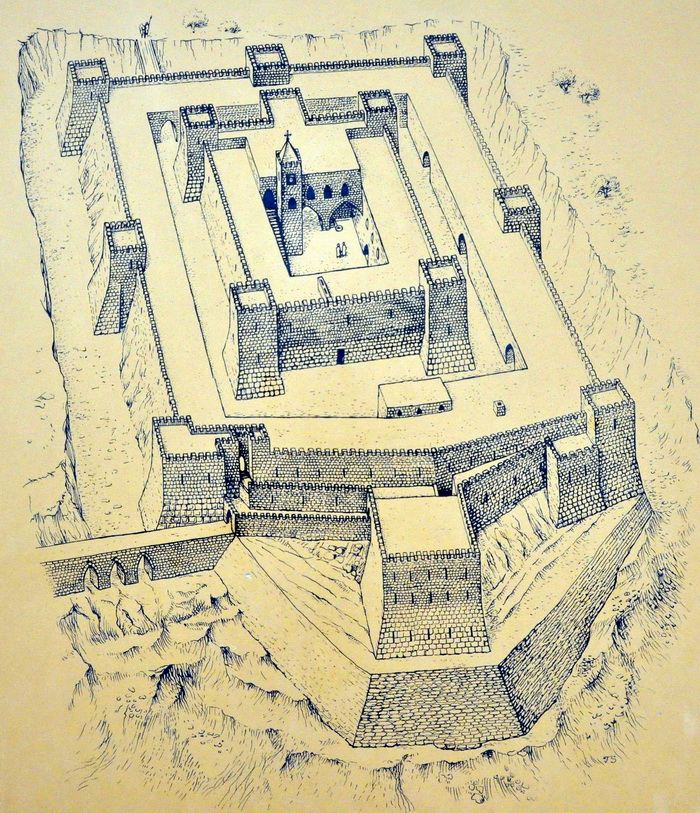 The fortress was built in Israel during the Crusader kingdom. It was home to a few dozen knights nearly 900 years ago. Even though the crusader kingdom was destroyed in 1187, this fortress managed to hold out for 18 months after the fall of the kingdom, despite being under continuous assault from the Muslims. During this time period back in Europe, the Silver Age for Ashkenaz Jewry had come to an end. Although the Crusader Kindom would not be established until 1099, Ashkenaz Jewry had already begun to be prosecuted. The first major stirrings of antisemitism in Franco-Germany began when Pope Urban II gave a speech in France in 1095. In his speech he called for the liberation of the Holy Land from the Muslims, and stirred up feelings of religious pride in many Christians. Inspired by the words of the Pope, Christian peasants began to march through the land massacring Jewish communities in what are now called the Tatnu massacres, because of the Jewish calendar year in which they occurred. Because European Jews living in Kehilot K'doshot (holy communities) were extremely prosperous, the peasants of the christian feudal system were enraged. They saw this as a direct contradiction to the witness theory, which stated that instead of killing the Jews for their involvement in the death of Jesus, they should be kept alive so that they could fail and wither while watching Christianity blossom and succeed.
Before leaving for lunch at kibbutz Affiqim, we stopped for a class picture just outside the second gate of the fortress.

After a frankly not-so-great lunch at kibutz Affiqim, we headed over to Tzfat to learn about the influx of Sephadic Jews and the advent of Jewish Mysticism. Mysticism is the idea of being able to transcend worlds to reach a plane of elevated spirituality. Most religions have some sort of mystical element, and it was in 16th century Tzfat that Jewish mysticism, or Kabalah was developed.

In the 11th century, Christians began to reconquer Spain from the Muslims. In 1391 a horrible wave of antisemitic violence swept the newly Christian country, resulting in the forced baptisms of some Jews, while others were simply burned at the stake,. In 1492 the Jews were officially kicked out of Spain, ending the Spanish Inquisition. Jews fled to the Ottoman Empire, which still recognized them as a well educated group of people who would be an economic asset. Many Jews moved to Turkey and Greece, but a significant portion returned to Israel. A large Jewish community had been developing in Tzfat for quite some time at this point, and was the choice destination of many immigrant Jews. Among the growing Jewish community in Tzfat, several great Rabbis emerged, whose ideas still greatly influence us today.
The three major rabbis in the mid 16th century in Tzfat who helped shape kabalah as we know it are Rabbi Yosef Karo, Rabbi Moshe Kordoverah, and H'Ari HaKadosh. Rabbi Yosef Karo was an expert in Jewish law, or halachah. He was a major advocate for traditional Judaism and wrote the Shulchan Aruch, or the set table. It was a compilation of Jewish texts designed to make following Jewish law as clear and easy as possible. Rabbi Moshe Kordoverah was a philosopher. Of the rabbis on this list, Moshe is my favorite. He was a proponent of a a subjective interpretation of Jewish texts,including the nature of god. Moshe said that god created the world and then disappeared. His interpretation of god suggested that god was more of a concept than an omnipotent deity. He said that there are an infinite level of moral steps to transcend to reach god, and that the goal of Judaism was just to make the world a better place. The final Rabbi is H'Ari HaKadosh, or in English, the Holy Lion. The Lion was the father of Kabalah as we know it today. He created it by combining the ideologies of the other two rabbis to allow him to transcend to a higher moral plane through the study of Torah and the following of Jewish laws. A famous legend says that the Lion wanted to stand on the shoulders of the other two rabbis and bring down the Messiah. Around this time Kabbalat Shabbat was thought up, and Shlomo Ha'Levi, a friend of Moshe's wrote L'cha Dodi, a staple of the Kabbalat Shabbat service


My question for you all, is which of the three Rabbis do you relate to the most, and why? Which Rabbi do you think had the biggest impact on modern Judaism?


I can easily say that I relate most to Rabbi Moshe Kordoverah. As I have mentioned many times before, my Judaism is not a God but rather my set of values. I feel like Rabbi Moshe Kordoverah's ideals most emphasize the way that one person treats another, which relates very much so to the value of social justice, which is very important to me. I like how Rabbi HaKadosh tried to find a balance, but I do not live by that balance. Rabbi HaKadosh had the biggest contribution to modern Judaism, and this can be seen with how we still have Kaballat Shabbat today, along with many of his other traditions. He founded Kabalah.
ReplyDeleteI agree with Zach and Dani, Moshe is my favorite Rabbi because of what he said about God being a concept more than something that actually exists. Also Moshe preached and was a philosopher, and not all Rabbis do that so I think he was cool. Also, believing God was more popular back in the days, so Moshe contributed into modern Judaism more than anyone else, esp. because the other rabbis had more of a traditional mindset.
ReplyDelete-GOLDIE
I relate most to Rabbi Moshe because I believe that God is a concept, and not an actually existing being. His values are more about being a good person and having spirituality instead of only going to yeshiva.
ReplyDeleteI relate most with Moshe because he is the least about got and most about the culture, which is what I think too. I also think he contributed the most to modern Judaism because he had different beliefs that expanded peoples thoughts.
ReplyDeleteI, too, agree with Rabbi Moshe Kordoverah the most, as I find myself to be most aligned with his beliefs on Judaism. I do not believe in god as an actual higher power, but accept that the concept of god has much power in the people that do believe. My personal Judaism is much more a cultural aspect of my identity than anything else. However, I think Rabbi Hakodash actually had the largest impact on Judaism as he tried to find a balance that is still used by many jews today.
ReplyDeleteI agree mostly with Rabbi Moshe. I think we should put more emphasis on the values we have. Personally that is how I follow Judaism. He emphasizes jewish law which to me is emphasizing social justice which I think is most important. I also think he had the biggest impact on modern society, at least im reform judaism. This is practically all we talk about at my youth group and synagogue. I think Jewish law it is one of the most practiced parts of Judaism because you can observe Jewish law without feeling any spiritual connection to God. This makes it easier to practice for people today.
ReplyDeleteI agree with rabbi Ha'Ari HaKadosh because what he did was combined spirituality with prayer. I am more spiritually connected to Judaism but I believe that to interpret the Torah spiritually you still have to learn it. We still have to learn some of the Torah to know and understand the concept of morals and in general the concept of Torah. That is why Ha'Ari decided to combine spirituality with studying the Torah in my belief.
ReplyDeleteI personally connect more with Rabbi Moshe Kordoverah because Judaism to me is more about it's values. I can fully relate to his belief that one of Judaism's main purpose is to make the world a better place. Of all the lessons Judaism teaches, I feel like those that teach to treat others, social justice, and repairing the world are the most important, which is what Moshe emphasized.
ReplyDeleteI most likely associate and agree with rabbi Moshe because he’s shares more of my beliefs. He says that Judaism’s values, teachings and lessons are more what our religion is based upon rather than prayer
ReplyDeleteMoshe! His beliefs really stand out as something that transcends normal human spirit. His call to values identify with my beliefs.
ReplyDelete